
Here we are! Ready to go!!
Monday, July 9, 2012

Critter count, and other counts
No pictures here for obvious reasons. The totals so far (and we're going to keep counting all the way home) are:
Armadillo, roadkill: 59
Armadillo, live: 1
Possum, roadkill: 5
Turtle, roadkill: 7
Turtle, live: 2
Frog, live: 1
Frog, roadkill: most visible residue lacking positive identification, due to minimal remaining evidence, thus count not verified
Bags of garbage collected on our exercise walks to and from the gym and beyond: 28
Dozen cookies baked: 46
Armadillo, roadkill: 59
Armadillo, live: 1
Possum, roadkill: 5
Turtle, roadkill: 7
Turtle, live: 2
Frog, live: 1
Frog, roadkill: most visible residue lacking positive identification, due to minimal remaining evidence, thus count not verified
Bags of garbage collected on our exercise walks to and from the gym and beyond: 28
Dozen cookies baked: 46
West Point gets Boiled!!

We couldn't leave West Point without treating them to our (now famous throughout the Mission) Cajun Boil. When we learned of the unofficial official non-party party, we volunteered to bring the main course. It was enjoyed by all. Here's Elder Johnson and Jerry Moore showing off the brew that's nearly ready.

Carrying the pot - it's Suppertime!

Here's some of our good friends socializing before Supper: Brenda Pounders, Larry Foster, Cheryl Wilson, Beverly Shields, and Jack Redwine.

Lewie Shields and Larry Foster. Larry is a Decorated Veteran from the First Marine Division, Vietnam era. He still loves the Corps, and wears his vest nearly everywhere he goes.

Sister Johnson and more of her friends (when will she ever have enough?). Sara Beth Crump and Erin Honsinger are seated next to their mother Sherry Honsinger, who's next to Sister Johnson

Our good friends Cary and Cheryl Wilson enjoying Ba-wol and fixin's. Br. Wilson is the 2nd counselor in the branch presidency, and Sister Wilson is the 1st counselor in the Relief Society.

John and Beverly Shields. Br. Shields is 1st Counselor in the branch presidency.


As you must know by now, the West Point branch is very dear to us. We love these wonderful people who demonstrate such dedication and commitment. They continue to be an inspiration to us. We'll always carry with us the memories of our time spent here.
Howlin' Wolf, the Blues Legend

We got a real treat on July 5th - a personal tour by the curator of the Howlin' Wolf Blues Museum, and the caretaker of his legend, our friend Richard Ramsey. Here's Richard outside the Museum in West Point.


 Richard conversing with Sister Johnson on his most passionate subject: Howlin' Wolf. The Annual Howlin' Wolf Memorial Concert will be held in West Point this year on August 31. Unfortunately, we'll miss it, but if we were still in Mississippi, we'd be there for sure.

I can't do justice to the influence that Chester A. Burnett AKA Howlin' Wolf had on the blues, jazz, rock, country, and most other genres of modern music. Richard has dedicated a significant portion of his life to promote and preserve the memory of this musical giant. I'll try to get a better description of The Wolf inserted later, but if you're a music lover, Google his name to see what a force he was on all the music of today. Wolf was born just outside West Point in 1910, and played his music up til the time of his death in 1976.

Richard schools Sister Johnson on the memorabilia of Howlin' Wolf that he's collected.

More of the memorabilia and history in the Museum.


The Howlin' Wolf Memorial in West Point.
Sunday, July 8, 2012
Elder Jones gets retired

Anyway, it's smooth riding and no flats for him from now on.
4th of July in Mississippi


Next out of the smoker is??:


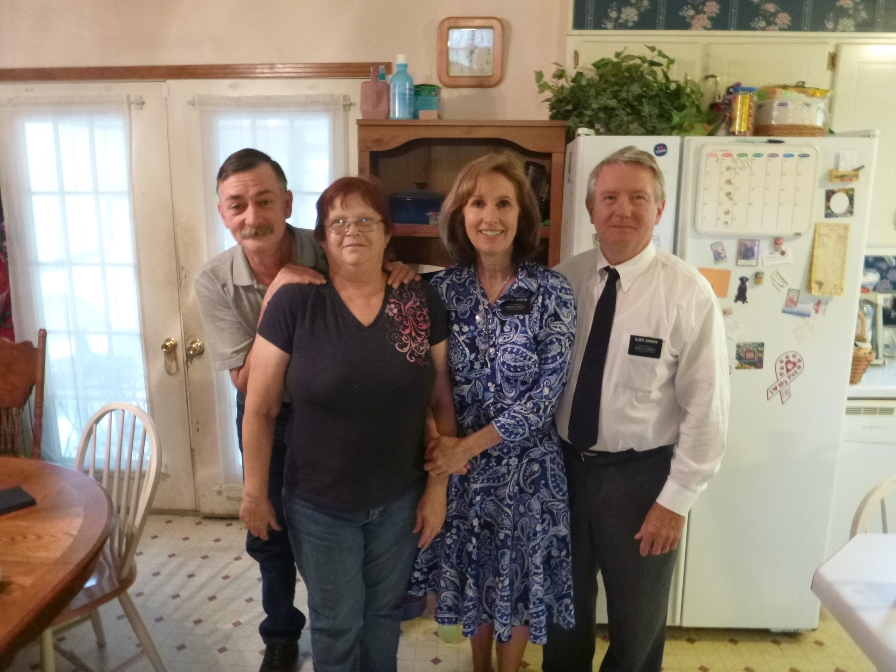

Off to Starkville later for ANOTHER 4th of July celebration, hosted by our good friend Geneene Saunders, who invites the whole Starkville branch over for food and fun. Sister Johnson got to meet up with some of her best friends again.

Couldn't leave out Jai. He's been playing badminton and eating nonstop, but took time out for a quick photo.

I got a picture with another of our favorite people, Marie. Do we have anyone who's not our favorite? I think not. She's the Mom of the kids above.

Sister Johnson get a BIG hug from Achilles. The picture is deceiving, he's about 3X her size, and the Dad of the girls and Jai. Stay tuned for more news about Achilles, Marie, and their family.
After all this, we went home before the fireworks started. Growing up in Lava Hot Springs and Coeur d' Alene ID, where they have REAL fireworks, we decided to get home and get some rest after a very busy day, so we missed the Starkville display.
Waiting out the rain

We've been having some summer rainstorms that come on quite suddenly, and dump a lot of rain in a short time. We just got back from rescuing the Elders Jones and Campbell - way out on the east side of Starkville, with a flat tire, no less. The rain was still coming down after we got them and their bikes back to their apartment, and we drove to our. We had to wait another 20 minutes in the car before we'd even venture out.

After a rain like this, the humidity is near 100%, and mist just hangs in the air. We're now getting daytime temps around 100F, and experiencing the hot mugginess that southern summers are notorious for. We seem to be somewhat acclimatized to it. Mostly it's because we don't have to be out in it very long. If I was hoein' cotton all day, I'd just die.
Subscribe to:
Posts (Atom)